Phulkari,
pixel by pixel.
Pixelkari is a browser-based drawing tool inspired by the patterns of Phulkari, a traditional embroidery practice from Punjab. Create motifs, stamp patterns, explore old forms through new ways, and watch a new language emerge.
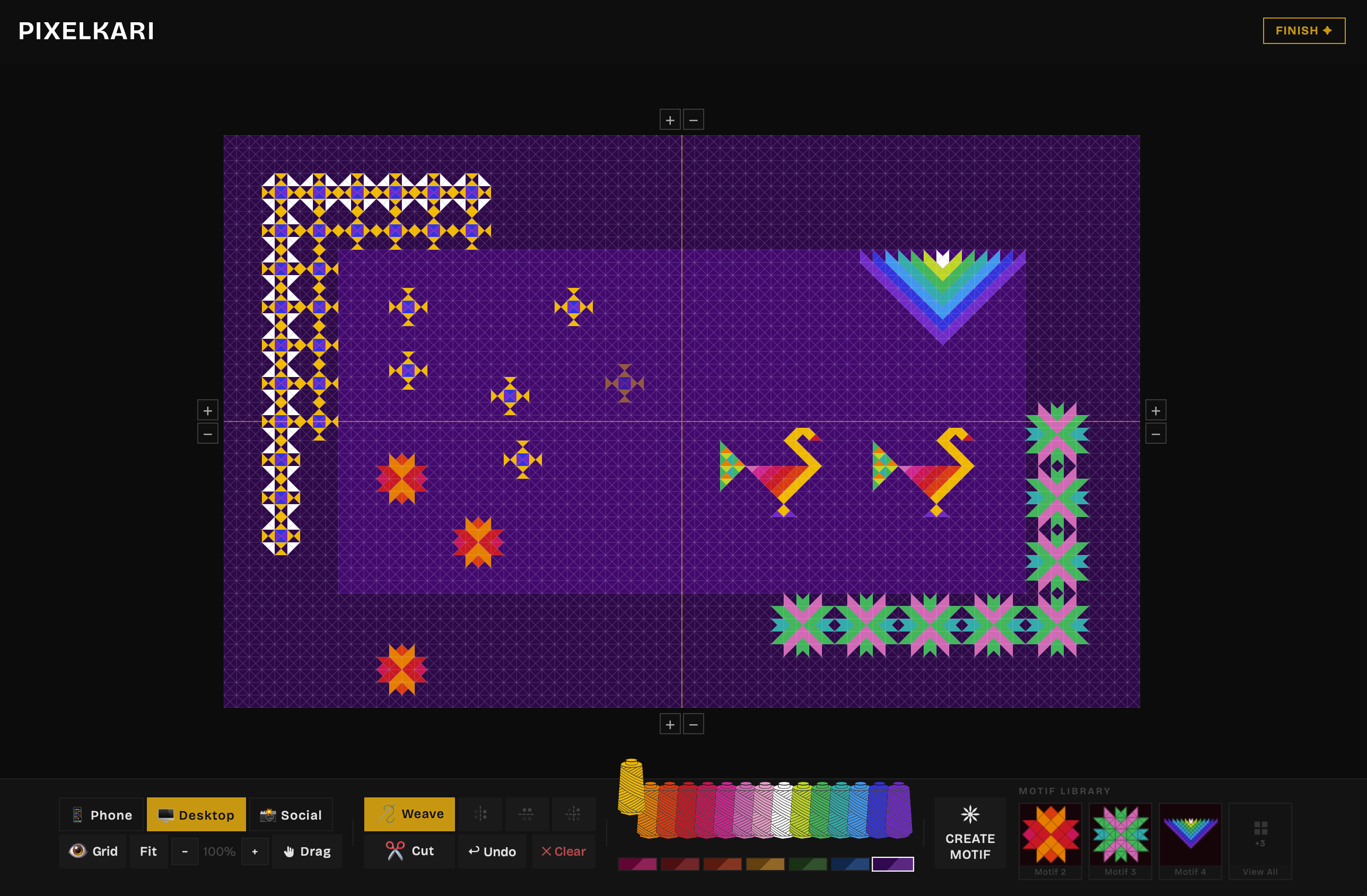
The tool — runs entirely in your browser
What is Pixelkari?
This tool came from a personal place. I come from a lineage of experienced hands. My nani crochets, tatts lace, knits, embroiders — hours given willingly to a single piece of cloth, each piece ultimately passed down through the generations. Between her generation and mine, the hand skills have quietly thinned.
Punjabis are one of the world's great migrant communities, carried by partition, opportunity, necessity, across every continent. Like many diasporic Punjabis, I never lived in Punjab. I grew up at a distance from the land and the communities who practiced these traditions. But the longing to understand where I come from, to find it, to hold it somehow, never left.
Pixelkari is my way of reaching back. A designer's interpretation of a craft that was never written down, only passed hand to hand. It is not a replacement but an entry point, an invitation to touch something old in a way that feels possible now. To learn familiar motifs, and to ask what new ones might look like.
You build motifs, save them, stamp them, watch something emerge. It takes time. Like all things made by hand, it asks for patience. But that is the point, to slow down, to count, to make something deliberately. The craft always worked that way. So does this.
What is Phulkari?
It is believed that the word phulkari bears close linguistic affinity with the Persian word gulkari — a popular form of embroidery in Iran. Phul and gul, both mean flower and kari means craft.
Phulkari (ਫੁਲਕਾਰੀ) is one of Punjab's oldest folk embroidery traditions — worked in vibrant silk thread on handspun cotton, built from geometric patterns of extraordinary precision and colour.
Passed down through generations, each piece was a personal document — a record of the maker's skill, her community, her season. A bride's dowry would include phulkaris her mother and grandmother had stitched for years in anticipation.
The patterns are built on a grid. Diagonal stitches counted across warp and weft. The geometry is strict; the colour is free. Motifs repeat across a field, borders frame the edges, and the whole becomes something larger than its parts.

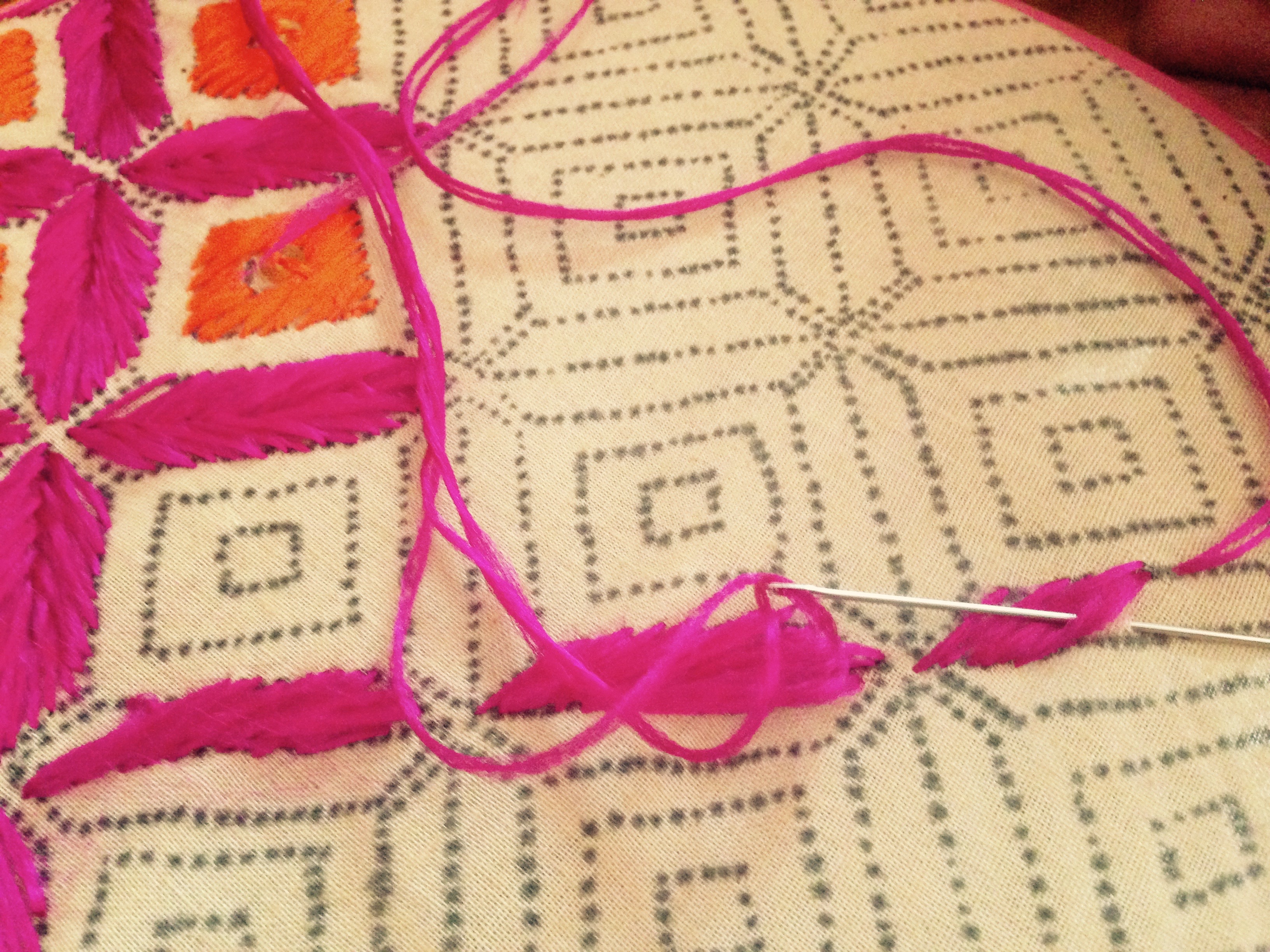
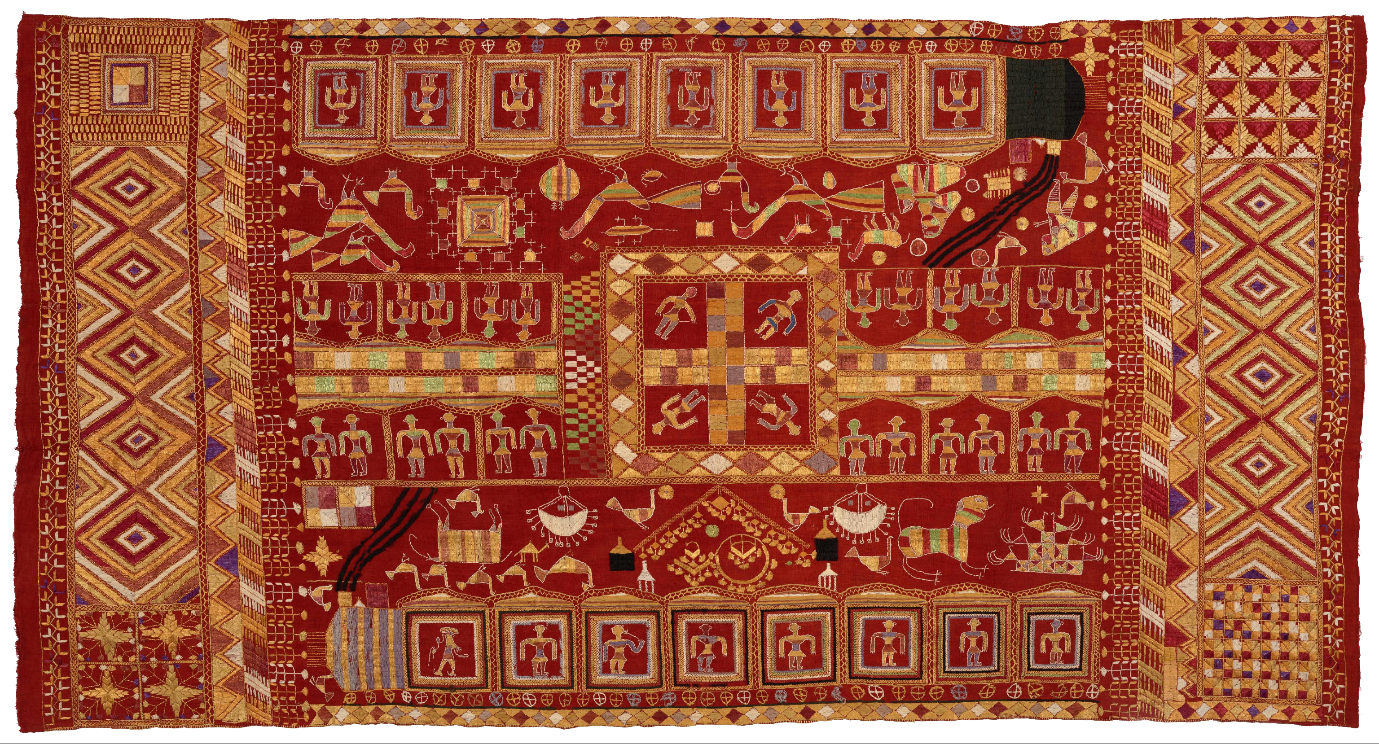
Photos: Sheebamadanloewinger / CC BY-SA 4.0 / Wikimedia Commons · Sainchi Phulkari (VI), Philadelphia Museum of Art
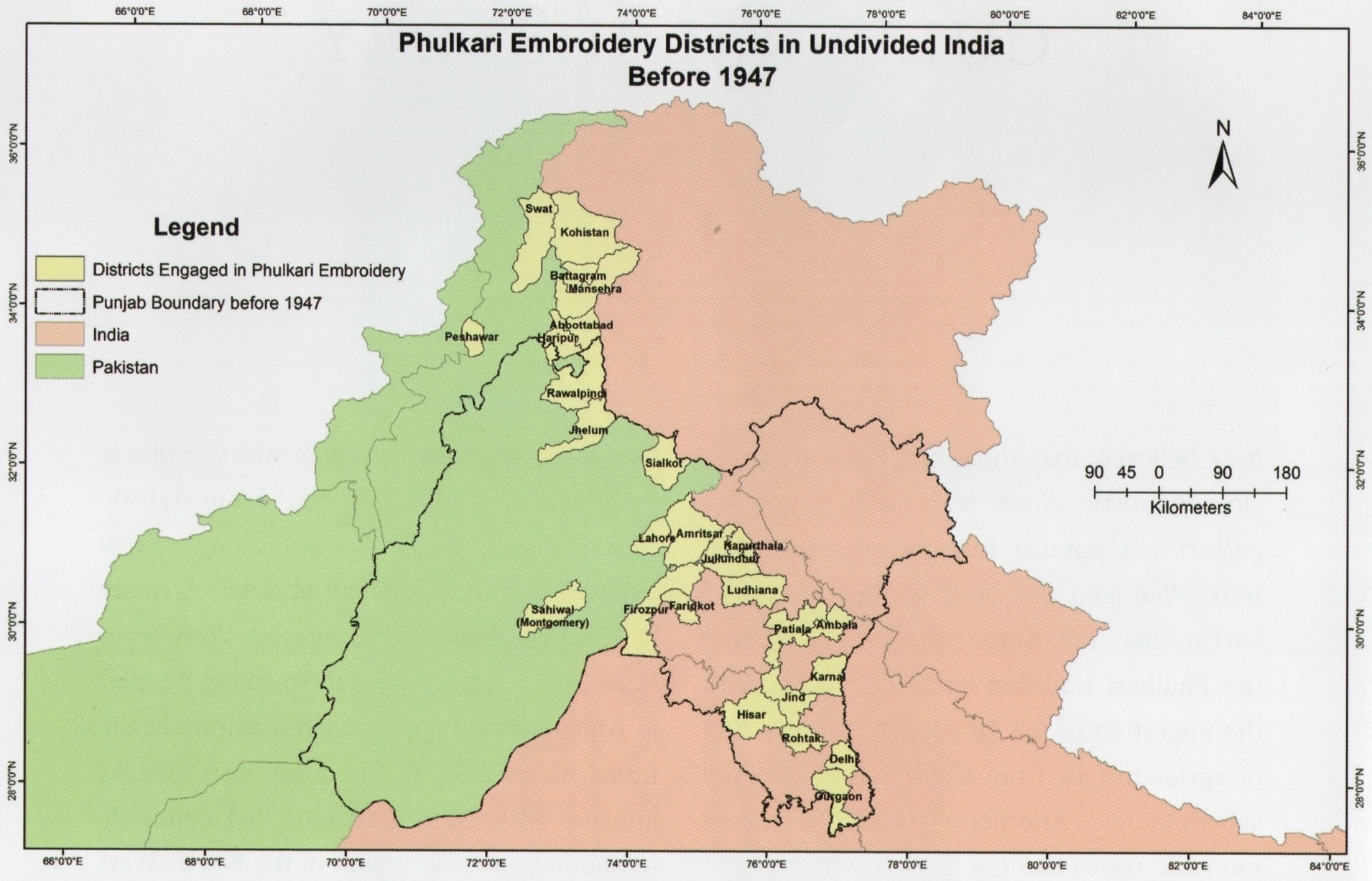
Phulkari unites a divided Punjab. Before 1947, the craft spread across undivided Punjab — from Peshawar and Rawalpindi in the northwest to Lahore, Amritsar, and as far south as Delhi. Phulkari districts clustered densely at the heart of Punjab, on both sides of what would become the partition line.
The craft depended on a living ecosystem. The silk floss thread — called pat — came from Kashmir, Bengal, and Central Asia, dyed locally, and sold by nomadic merchants moving village to village. The knowledge moved by hand and word, not document.
1947 ended this. Communities fractured. Phulkaris were abandoned during the flight across new borders. Trade routes collapsed. The displacement of over 14 million people pulled women from rural areas into cities, into survival.
Today, phulkari is both handmade and machine-made, widely available and widely worn. But the story it carries has thinned. The motifs are no longer a record of the maker's life, her community, her landscape. For most of the Punjabi diaspora, that connection was never passed down to begin with. What was once learned by proximity now has to be actively sought. Without that seeking, the knowledge quietly disappears.
The Heritage Lab — theheritagelab.in/phulkari-punjab
Scroll.in — scroll.in — How the Partition almost killed Phulkari
This is an ode to nani, mumma, and all maternal figures who carry collective memory through traditional crafts. May we learn from them, and carry on the work.
Create your first Pixelkari.
Runs entirely in your browser. No account, no installation.
Please open on desktop to use the tool